Synthesizability Scoring: SynScore
Task: assign a target molecule a synthesizability score in \([0,1]\) — how easily it can be synthesized from purchasable starting materials. Unlike structure-only heuristic scores (SAscore/SCScore/RAscore), SynScore actually runs a multi-step route search once and scores by "how many non-purchasable starting materials the best route still lacks", making it interpretable, rankable, and route-grounded.
1. Definition
Let \(U\) be the number of non-purchasable starting materials in the best route; then
| \(U\) | 0 | 1 | 2 | 3 | 4 | ≥5 | No route |
|---|---|---|---|---|---|---|---|
| SynScore | 1.0 | 0.5 | ≈0.111 | ≈0.016 | ≈0.0016 | ≤1e-3 | 0 |
- \(U=0\) (all leaves purchasable, depth ≤5) is called solved and earns the full score of 1.
- The score decays super-linearly with \(U\) — separating more steeply than a linear coverage measure such as "fraction of purchasable leaves", so that molecules closer to being fully solvable are pulled further apart.
- Choice of the best route: when solved, take the solution with the fewest reaction steps; when unsolved, fall back to the partial route with the smallest \(U\) (then coverage, then step count), to carry a "near-miss" signal.
The companion continuous metric bb_coverage (fraction of purchasable leaves in the best route) gives a smoother distribution than the binary solved flag in batch analysis.
2. Algorithm and pseudocode
SynScore is driven by SynthesizabilityScorer, which runs one planning pass and then aggregates
from the route:
function synscore(smiles, max_steps=5):
    result = planner.plan(smiles, max_depth=max_steps)     # see "Multi-step Route Planning"
    routes = result.routes
    solved = [r for r in routes if r.solved]
    if solved:
        best = argmin(solved, key = r.num_steps)           # the solution with the fewest steps
        coverage = 1.0
    elif routes:
        best = argmin(routes, key = (U(r), -r.bb_coverage, r.num_steps))
        coverage = best.bb_coverage
    else:
        return MoleculeReport(solved=False, bb_coverage=0)  # score recorded as 0

    U = number_of_non_purchasable_leaves(best)
    score = 1 / (U + 1) ** U
    return MoleculeReport(smiles, solved=(U==0), bb_coverage=coverage,
                          min_steps=best.num_steps, score=score, leaves=...)
Batch scoring score_batch runs sequentially (the planner holds the GPU + a shared cache,
which does not lend itself to naive multiprocessing; large-scale runs should shard at the shell
layer), can stream results to disk via a callback, and prints a live solve_rate to stderr. The
aggregated BatchReport reports solve_rate, mean_bb_coverage, a histogram by route depth,
and more.
3. Evaluation
3.1 U distribution (1000 ChEMBL)
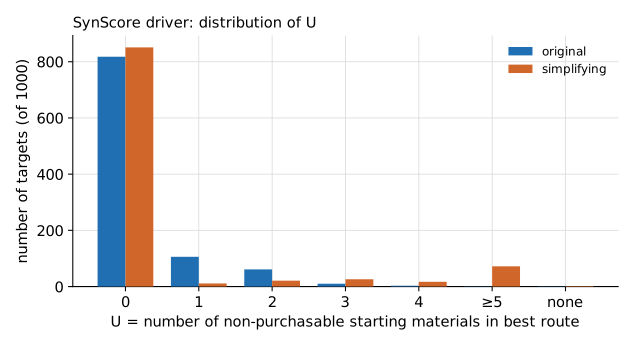
| U | 0 | 1 | 2 | 3 | 4 | ≥5 | No route |
|---|---|---|---|---|---|---|---|
| Original model | 818 | 106 | 61 | 10 | 3 | 1 | 1 |
| Simplified model | 851 | 11 | 21 | 26 | 17 | 72 | 2 |
When the original model fails to solve, it is usually short by only 1–2 non-purchasable starting materials (U concentrated at 1–2); the simplified model solves more (851 vs 818), but once it fails it is often much further off (72 targets with U≥5) — because it forces a disconnection at every step and cannot reach the "buy it in one step" endgame. These are exactly the two kinds of "unsolved" that SynScore's super-linear decay is meant to distinguish.
3.2 Positioning relative to structure-based baselines
Structure-based synthesizability scores are fast, but give inconsistent judgments even for molecules that are "obviously purchasable":
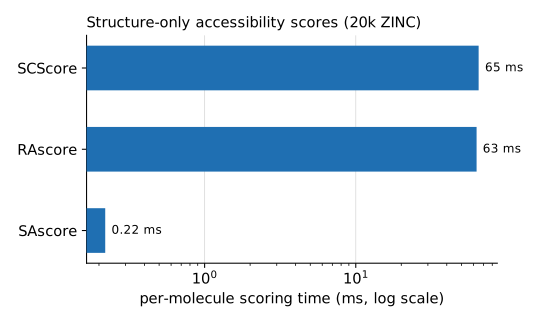
| Score | Range | Median/mean | "Off-ideal" fraction | Per-molecule time |
|---|---|---|---|---|
| SAscore | 1.3–7.2 | median 2.7 | 32% of scores >3 | 0.22 ms |
| RAscore | 0.001–1.0 | mean 0.91 | 17% of scores <0.9 | 63 ms |
| SCScore | 1.0–5.0 | median 3.7 | 99% of scores >2 | 65 ms |
On 20,000 already-purchasable ZINC building blocks, none of the three structure-based scores can give a consistent "trivially obtainable" judgment (each classifies a substantial fraction of purchasable molecules as relatively hard). SynScore makes the opposite trade-off: it pays the cost of one route search in exchange for a route-grounded judgment — expensive, but interpretable and able to produce a concrete route.
Note on scope
SynScore is a search-based metric, and its "time" is the multi-step search time (see the planning chapter, median ~0.3–0.5 s), which is not on the same axis as the structure-based scores in the table above, so no same-scale comparison is made; here we compare only "whether a consistent judgment can be given for purchasable molecules".
4. Limitations
- SynScore's quality is entirely determined by the underlying single-step model and building-block coverage: poor model recall or a small building-block set will both underestimate synthesizability.
- Each molecule requires one search, so the cost is far higher than structure-based scoring; large-scale screening needs sharded parallelism + caching.
- \(U\) only counts "the number of non-purchasable starting materials" and does not distinguish how far each of them is from purchasable — a deliberate simplification.