Single-step Retrosynthesis Prediction
Task: given a product SMILES, predict which reactant sets a one-step reaction can
break it into, and rank them. This is the atomic operation of the whole multi-step
planning process—predict(smiles, top_k) -> [Prediction].
The core is neural template classification: a D-MPNN reads the product molecular graph, applies softmax over 49,895 reaction templates, takes the top-k templates, and uses RDChiral to apply each template back onto the product, yielding candidate reactant sets. If torch is not installed, it degrades to a pure template-rule backend (ranked by template prior).
1. Model / algorithm architecture
flowchart TD
    P["Product SMILES"] --> G["Graph featurization<br/>largest fragment + Gasteiger<br/>ATOM_FDIM=45 / BOND_FDIM=12"]
    G --> M["D-MPNN encoder<br/>hidden=300 depth=3"]
    M --> H1["Template head → softmax(49,895)"]
    M --> H2["Reaction-center head (per-atom sigmoid)"]
    H1 --> T["top-k templates"]
    T --> AP["apply_template (RDChiral)<br/>product >> reactants"]
    H2 --> RK
    AP --> RK["_rank: within a template, break ties with center<br/>sort by (−template probability, −center mean)"]
    RK --> O["[Prediction(reactants, score, template_id)]"]
D-MPNN (directed bond message passing, Yang et al. 2019). The key is that messages are passed centered on directed bonds, and the reverse edge is subtracted during aggregation to prevent information from flowing back along the same bond:
- Edge initialization: \( h^0_{ij} = \mathrm{ReLU}(W_\text{in}[x_i \,\|\, e_{ij}]) \)
- Iterate
depth−1times: \( m_{ij} = \big(\textstyle\sum_{k} h_{ki}\big) - h_{ji} \), \( h_{ij} = \mathrm{ReLU}(h^0_{ij} + W_\text{hid}\, m_{ij}) \) - Atom aggregation: \( h_i = \mathrm{ReLU}(W_\text{out}[x_i \,\|\, \textstyle\sum_k h_{ki}]) \)
- Graph readout
sum→ template logits; plus per-atom reaction-center logits
Role of the reaction-center head (a key design): the center probability is used to break ties only within the same template probability (i.e., among different substructure matches of the same template), thereby improving top-1 while not losing top-K coverage—it does not participate in cross-template reranking.
Input features (atom 45-dim / bond 12-dim)
The retro and forward models share one featurization
(synomega/chem/features.py, vendored verbatim from the training repo
ml-template-gnn). Gasteiger charges are computed on the molecule before graph
construction.
Atom features ATOM_FDIM = 45:
| Feature | Encoding | Dims |
|---|---|---|
| Element | one-hot: C, N, O, F, P, S, Cl, Br, I + "other" | 10 |
| Total degree (incl. implicit H) | one-hot: 0–5 + "other" | 7 |
| Formal charge | one-hot: −2, −1, 0, +1, +2 + "other" | 6 |
| Chirality tag | one-hot: unspecified / tetrahedral CW / tetrahedral CCW / other (no "other" bucket) | 4 |
| Total H count | one-hot: 0–4 + "other" | 6 |
| Hybridization | one-hot: sp, sp², sp³, sp³d, sp³d² + "other" | 6 |
| Is aromatic | 0/1 | 1 |
| Is in ring | 0/1 | 1 |
| Atomic mass | scalar, ×0.01 | 1 |
| Pauling electronegativity | scalar, ÷4 (table lookup; 2.0 default off-table) | 1 |
| Gasteiger partial charge | scalar (set to 0 when RDKit cannot compute it) | 1 |
| Gasteiger valid flag | 0/1, marks whether the previous value is finite/valid | 1 |
Bond features BOND_FDIM = 12:
| Feature | Encoding | Dims |
|---|---|---|
| Bond order | one-hot: single / double / triple / aromatic (no "other" bucket) | 4 |
| Is conjugated | 0/1 | 1 |
| Is in ring | 0/1 | 1 |
| Bond stereo | one-hot: none / any / Z / E / cis / trans (no "other" bucket) | 6 |
The element vocabulary is just the nine common organic elements C/N/O/F/P/S/Cl/Br/I;
everything else (metals, B, Si, …) falls into the "other" bucket — an
organic-synthesis-oriented feature set; chirality (4-dim) and bond stereo (6-dim)
are both kept. The three continuous scalars (mass, electronegativity, Gasteiger charge)
are scaled/normalized to the 0/1 range of the one-hots so they do not dominate. The
D-MPNN passes messages over directed bonds (each bond becomes two edges sharing the
same 12-dim bond feature). A per-position dimension guard on the checkpoint at load time
(W_input.weight width must equal ATOM_FDIM+BOND_FDIM) makes any drift from the
training-time featurization fail loudly rather than corrupt predictions silently.
2. Pseudocode
function retro_predict(product_smiles, top_k=50, topk_templates=50):
    g = graph_featurize(largest_fragment(product_smiles))    # + Gasteiger
    tpl_logits, center_logits = DMPNN(g)                     # center is optional
    probs  = softmax(tpl_logits)
    center = sigmoid(center_logits)                          # per-atom
    top_labels, top_probs = topk(probs, topk_templates)

    cand = {}                          # reactants(tuple) -> (tpl_prob, center_avg, label)
    for (label, prob) in zip(top_labels, top_probs):
        smarts = template_library[label]                     # product >> reactants
        for outcome in apply_template(smarts, product_smiles):
            c = mean(center[a] for a in outcome.match_atoms) if center else 0
            key = outcome.reactants
            cand[key] = max(cand.get(key), (prob, c, label))  # keep the better score for identical reactants
    ranked = sort(cand, key = (-tpl_prob, -center_avg))
    return [Prediction(reactants, score=tpl_prob, template_id) for ... in ranked[:top_k]]
apply_template (RDChiral style): the template's reactant pattern is the product
pattern, and RunReactants((product,)) generates each outcome; matched atoms are assigned
to an outcome only when the number of substructure matches aligns with the number of
outcomes (used for center averaging); each product undergoes SanitizeMol, atom-map
clearing, and canonicalization, any failure discards the whole outcome, and results are
returned after deduplication (default max_outcomes=64).
3. Simplification-constrained model
A parallel single-step variant: it restricts the action space to "simplifying" templates—writing the retro direction, the product is a single molecule and the reactants are two or more molecules (i.e., every step breaks the target into smaller precursors). This is a data-layer constraint (the model can only emit simplifying disconnections), not an inference-time reranking.
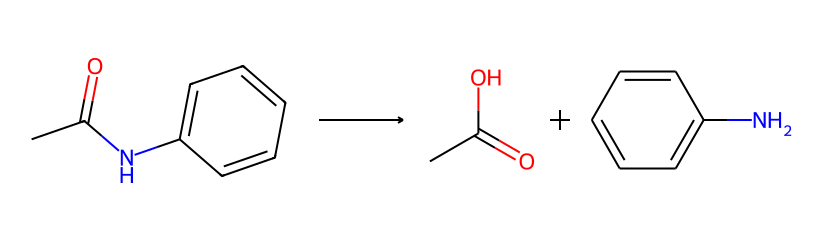
- Of the 49,895 templates, 33,651 (67.4%) are simplifying, forming the label space of the constrained model.
- The constrained model is warm-started from the encoder and reaction-center head of the original model, reinitializing only the template classification head (the label space differs).
- Positioning (honest): the simplification constraint delivers a multi-step search-efficiency gain (fewer expansions, faster, no drop in solve rate, see Multi-step planning), NOT a "simpler = more reasonable" plausibility novelty.
4. Training set and evaluation
For the training corpus and template extraction, see the Overview.
| Model | Evaluation convention | top-1 | top-10 |
|---|---|---|---|
| Original model (r20, 49,895 classes) | Independent val/test split | 0.451 | 0.830 |
| Simplification-constrained model (33,651 classes) | held-out | 0.555 | 0.911 |
The two top-1 values are not directly comparable
The simplification model has a smaller label space and a more constrained task, so its top-1 is naturally higher; because the two label spaces differ, the numbers cannot be compared directly. Both sets of numbers come from the training/validation records of the deduplication-retrained models (0.10.0).
Architecture and training hyperparameters (identical for both models, excerpt): D-MPNN
hidden=300 / depth=3 / dropout=0.1, template head head_hidden=600, center head
hidden=128; AdamW, lr=1e-3, weight_decay=1e-5, cosine + 2000 warmup,
label_smoothing=0.1, grad_clip=5, mixed precision; templates applied via RDChiral.
5. Limitations
- The template method can only reproduce reaction types seen in the corpus; long-tail templates have sparse samples, so recall of rare reactions is limited.
- top-k coverage is limited by the granularity of the template library; radius-0 templates have weak control over site/stereo (affecting both plausibility and forward reproduction, see the corresponding chapters).