Single-step Forward Reaction Prediction
Task: given a set of reactants, predict the most likely product and rank the candidates.
SynOmega's forward prediction is a mirror of the retrosynthesis single-step model: it reuses the same 49,895 reaction templates and the same D-MPNN template classifier, and only at the application stage does it reverse the retrosynthesis template and apply it forward to the reactants with RDKit. It is template-based, interpretable, and shares its template library with retrosynthesis; it does not aim for SOTA end-to-end accuracy.
1. Model / algorithm architecture
flowchart TD
    R["Reactant SMILES<br/>A.B (multiple molecules)"] --> G["Graph featurization<br/>keep all fragments + Gasteiger"]
    G --> M["D-MPNN encoder"]
    M --> S["softmax over 49,895 templates"]
    S --> T["top-k forward templates"]
    T --> INV["Template inversion<br/>retro >> → forward >>"]
    INV --> A["RDKit RunReactants<br/>fragment permutation fills template slots"]
    A --> F["Sanitize + radical filtering<br/>take largest organic fragment"]
    F --> D["Rank products by (max template probability, number of producing templates)"]
D-MPNN encoder (ForwardTemplateGNN, sharing weights with retrosynthesis):
hidden_dim=300, depth=3, dropout=0.1, readout sum; template classification head
head_hidden=600, head_dropout=0.2, softmax to 49,895 classes; reaction-center head
center_head_hidden=128 (loaded but not used in forward ranking).
The atom and bond features are field-for-field identical to retrosynthesis
(ATOM_FDIM=45 / BOND_FDIM=12; see the "Input features" section on the
retro page for the full breakdown). The only difference from retrosynthesis
featurization: the forward input is a set of
multiple reactants, so _graph does not perform largest-fragment truncation—it
keeps all reactant fragments (otherwise the second reactant would be dropped) and computes
Gasteiger charges. This is guaranteed on the training side by the featurization switch
TGNN_KEEP_ALL_FRAGS=1, consistent with the inference side.
Template inversion and forward application (apply_template_forward): a
retrosynthesis template is written as product >> reactants; splitting on >> and
recombining as reactants >> product yields the forward reaction, and the forward
reactant side may have multiple template slots. The reactants are split into fragments,
permutations enumerate the ordered assignments of fragments to template slots, and
RunReactants(..., maxProducts=1000) generates candidate products.
Radical / carbene artifact filtering
When a radius-0 template is applied forward, RDKit adds radical electrons to
undervalent atoms (for example [C]=O with valence 3), generating chemically
unreasonable carbene/acyl-radical products, and RDKit only rejects overvalence,
not undervalence. Therefore each product is forced through a
num_radical_electrons == 0 filter, then the largest organic fragment is taken, the
atom map cleared, and the molecule canonicalized, giving a SMILES in the same form as
the true product.
2. Pseudocode
function forward_predict(reactants_smiles, top_k=10, topk_templates=10):
    g = graph_featurize(reactants_smiles)      # keep all fragments + Gasteiger
    logits = DMPNN(g)                          # ignore the center head
    probs  = softmax(logits)
    top_labels, top_probs = topk(probs, topk_templates)

    best = {}                                  # product -> [max_prob, n_templates, template_id]
    for (label, prob) in zip(top_labels, top_probs):
        retro_smarts = template_library[label]
        for product in apply_template_forward(retro_smarts, reactants_smiles):
            if product not in best:
                best[product] = [prob, 1, label]
            else:
                if prob > best[product][0]:
                    best[product][0] = prob
                    best[product][2] = label
                best[product][1] += 1          # how many templates can yield this product
    ranked = sort(best.items(), key = (-max_prob, -n_templates))
    return [ForwardPrediction(product, score=max_prob, template_id) for ... in ranked[:top_k]]

function apply_template_forward(retro_smarts, reactants_smiles):
    fwd_rxn = invert(retro_smarts)             # "L>>R" -> "R>>L", strip one outer paren layer
    frags = fragments(reactants_smiles)
    if len(frags) == 0 or len(frags) > 8: return []      # pathological-input guard
    nslots = fwd_rxn.num_reactant_templates
    if len(frags) < nslots: return []
    outcomes = []
    for assignment in permutations(frags, nslots):       # enumerate fragment -> template-slot assignments
        for product in RunReactants(assignment, maxProducts=1000):
            sanitize(product)
            if any_radical(product): continue            # drop carbene/radical artifacts
            outcomes.append(canonical_largest(product))
            if len(outcomes) >= 64: return dedup(outcomes)
    return dedup(outcomes)
Ranking intuition: a product inherits "the maximum probability among all templates that produce it"; products with equal probability are ordered by "how many templates can produce it" in descending order (the more templates support it, the higher it ranks).
3. Training set
- Source: the same atom-mapped reaction corpus as retrosynthesis, radius-0 / min-count 20, 49,895 template classes.
- Scale: the corpus has 15,809,108 reactions; the forward task effectively uses about 13–14M for training / ~790K for validation / ~790K for testing.
- Split: by reaction id
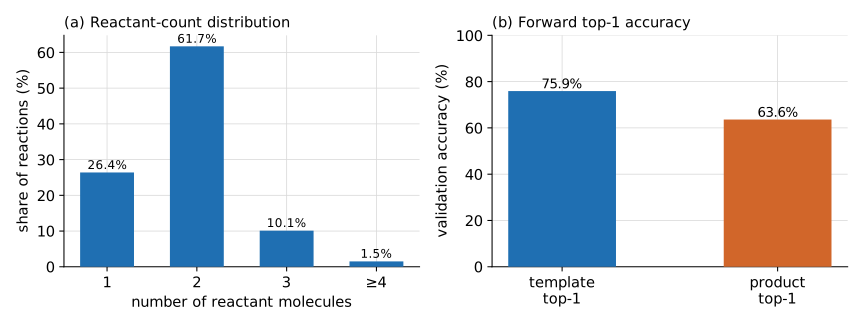
% 20—0 → test,1 → val, the rest→ train(same convention as retrosynthesis). - Distribution of the number of reactant molecules (see figure below): single reactant 26.4%, two 61.7%, three 10.1%, ≥4 is 1.5%; multi-molecule (≥2) reactions account for 73.6%—which is exactly why "keeping all fragments" is necessary.
Training hyperparameters: batch_size=256, epochs=50, AdamW, lr=1e-3,
weight_decay=1e-5, warmup_steps=2000, cosine, label_smoothing=0.1, grad_clip=5,
mixed precision, seed=42; reaction-center head BCE, center_pos_weight=25.
4. Evaluation metrics
On the validation set (id%20==1):
| Metric | Value |
|---|---|
| template top-1 | 0.756 |
| product top-1 | 0.623 |
Product top-1 is lower than template top-1 because of a structural ceiling of the template method: even when the correct template is hit, applying it forward to the reactants does not necessarily reproduce the true product uniquely (regio-/site-level ambiguity).
Only report numbers with a source
Validation top-5 / top-10, center F1, self-recovery, and similar metrics have no
persisted result file in this repository, so they are not listed here, to avoid
numbers without a source. The software tests set a regression lower-bound assertion on
product top-1 (product_top1 ≥ 0.55).
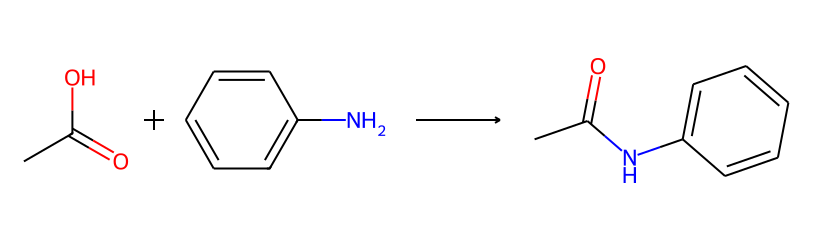
Demonstration predictions: in a set of 8 examples, top-1 hit 6 and missed 2; both misses occurred on single-reactant inputs (the model chose the wrong disconnection site). The figure below is a forward illustration of an "amide coupling"—carboxylic acid + amine → amide:
5. Limitations and positioning
- The accuracy ceiling is limited by "whether the template can reproduce the product forward", not end-to-end SOTA; its value lies in sharing templates with retrosynthesis, being interpretable, and requiring zero additional training (reusing the same checkpoint).
- Cross-molecule message passing is not explicitly modeled in v1 (the classification head relies on the sum readout to jointly see all reactants); long-tail logit adjustment, virtual global nodes, and the like are future directions.