Reaction Plausibility Scoring
Task: given a reaction (reactants + product), output a plausibility score in \([0,1]\) — how chemically likely it is to actually occur. Its purpose is to judge "how trustworthy is this step" for single-step retrosynthesis candidates.
This is a binary classifier: positives = high-yield real reactions; negatives = "superficially plausible but never actually happened" wrong products generated by templates on the same reactants.
1. Model / algorithm architecture (shipped model: dual-tower D-MPNN)
The plausibility model shipped with SynOmega is DualPlausibilityNet (checkpoint
plaus_dual-best.pt) — a dual-tower, atom-mapping-free architecture:
flowchart TD
    RIN["Reactant graph A.B<br/>(a single disconnected graph)"] --> ER["D-MPNN encoder<br/>enc_r"]
    PIN["Product graph"] --> EP["D-MPNN encoder<br/>enc_p (shares weights with enc_r)"]
    ER --> HR["h_r"]
    EP --> HP["h_p"]
    HR --> CAT["Combined feature<br/>[h_r, h_p, h_p−h_r, h_p·h_r]"]
    HP --> CAT
    CAT --> MLP["MLP → 1 logit"]
MLP --> SIG["sigmoid → plausibility ∈ [0,1]"]- The two towers (
enc_r,enc_p) independently encode the reactant graph and the product graph (no CGR, no atom mapping); whenshared=Truethey share a single set of D-MPNN weights. - The combined feature
[h_r, h_p, h_p−h_r, h_p·h_r](4×hidden) is fed to the headLinear(4h → 300) → ReLU → Dropout → Linear(→1), which outputs a single logit turned into a score by sigmoid. - Hyperparameters:
hidden_dim=300,depth=4,dropout=0.1,head_hidden=300. The scorerPlausibilityScorerloads this checkpoint, applies an LRU cache over graphs, and scores in batches ofbatch_size.
There is also a research variant
The research repo reaction-plausibility/ additionally contains a CGR (Condensed Graph
of Reaction) + D-MPNN single-graph variant (plaus_full): it superimposes the reactant
and product graphs into one, encodes the "change", and uses MCS to find atom correspondence.
It is not the shipped model; this page treats the dual-tower shipped model as
authoritative, and both share the training-data pipeline described below.
2. Pseudocode
function score_reaction(reactants_smiles, product_smiles):
    g_r = mol_to_graph(reactants_smiles)   # "A.B" as a single disconnected graph; ignore atom map
    g_p = mol_to_graph(product_smiles)
    if g_r is None or g_p is None: return 0.0
    h_r = DMPNN_enc(g_r);  h_p = DMPNN_enc(g_p)
    feat = concat(h_r, h_p, h_p - h_r, h_p * h_r)
    return sigmoid(head(feat))              # ∈ [0,1]
3. Training data
- Positives: reactions in the condition-annotated corpus with yield > 95% (100k seeds taken by default) — high yield ≈ genuinely occurred.
- Negatives (template-generated hard negatives, not randomly swapped products):
- Same template: take the seed's own radius-0 template, run it forward on its reactants, and any product ≠ the true product becomes a negative (≤ 3 per seed).
- Different template: run other templates on the seed's reactants (pool = 49,895 templates), and products ≠ the true product become negatives (≤ 5 per seed).
- Two data-quality fixes (otherwise the classifier learns shortcuts):
- A "negative" differing only in stereochemistry is actually a diastereomer of the true product → strip stereochemistry from all positives and negatives.
- Low-specificity templates such as deprotection would treat a leaving group / by-product as the "product" → keep only generated products whose heavy-atom count falls within [0.6, 3.0]× of the true product.
- Split: a deterministic split by hashing the seed id ≈ 90/5/5 (positives and negatives of
the same seed go into the same split to prevent leakage); negative:positive ≈ 4–5×, and
training uses a weighted BCE with
pos_weight=4. The absolute sample counts per split were not persisted in this repo.
Training hyperparameters: batch_size=256, epochs=40, AdamW, lr=5e-4, weight_decay=1e-5,
grad_clip=5, mixed precision, early stopping on val AUC (patience=6).
4. Evaluation: strong on the training axis, net-negative on the usage axis
Training/validation axis: the model reaches val AUC = 0.9946 on the validation set — strong discriminative power on the training axis of "fix the reactants, judge whether the product is right or wrong".
But using it to filter single-step retrosynthesis candidates is a net-negative. Across 998 targets, after deleting single-step candidates by plausibility score (delete only, no re-ranking), the top-1…top-10 hit rates all decrease slightly (−0.2 ~ −0.9 pp):
| Configuration | top-1 | top-3 | top-5 | top-10 |
|---|---|---|---|---|
| No filter | 0.3798 | 0.5471 | 0.6112 | 0.6764 |
| Threshold 0.3 | 0.3758 | 0.5461 | 0.6062 | 0.6713 |
| Threshold 0.4 | 0.3758 | 0.5451 | 0.6052 | 0.6713 |
| Threshold 0.5 | 0.3778 | 0.5411 | 0.6022 | 0.6683 |
Discriminative power is weak on the usage axis — the median plausibility of correct vs. wrong candidates is only 0.995 vs 0.973, with heavily overlapping distributions:
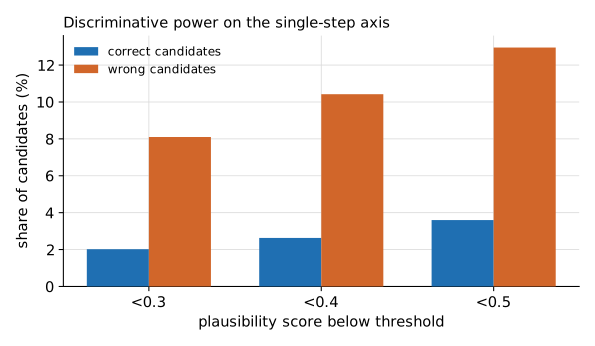
Root cause: the training axis (fix reactants, swap product) and the usage axis (fix product, swap reactants) are orthogonal. The biases the model learns on the training axis (e.g. penalizing real reactions with "a reactant leaving", OOD on large / multi-component molecules) cause it to wrongly delete true candidates on the usage axis.
Hence off by default
Based on the above evaluation, single-step plausibility filtering is off by default in
SynOmega; the feature is retained and can be explicitly enabled
(Planner(..., plausibility=...)). Under multi-step planning the filter does not change the
solved rate (23/25), but makes the median search time about 3.3× slower — further
support for keeping it off by default.
5. Limitations
- Template negatives are inherently hard negatives, and the size-band filter cannot remove all legitimate alternative products (regioisomerism, genuine side reactions).
- What is needed is a discriminator that "fixes the product and judges whether the reactant set is feasible"; the current model's training axis does not match this, and the direction for improvement is to reconstruct the negatives and training objective along the usage axis.