Byproduct reconstruction
Reaction records usually keep only the major product. An acid and an alcohol make an ester and the record says ester — the water is gone. Templates behave the same way: they rewrite what they were written to rewrite and drop the rest.
omgkit can put those atoms back.
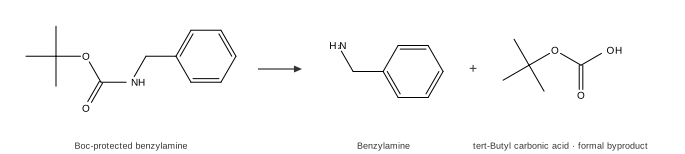
What comes back is the formal byproduct: the balanced molecule. For Boc deprotection that is tert-butyl carbonic acid — not the carbon dioxide and isobutylene you actually isolate. See what you get is the formal byproduct below.
>>> acid = omgkit.parse_smiles("CC(=O)O"); acid.sanitize()
>>> amine = omgkit.parse_smiles("CCN"); amine.sanitize()
>>> rxn = omgkit.parse_reaction("[C:1](=[O:2])[OH].[N:3]>>[C:1](=[O:2])[N:3]")
>>> out = rxn.run([acid, amine], byproducts=True)[0]
>>> [p.to_canonical_smiles() for p in out.byproducts]
['O']
>>> out.byproduct_verdict
'capped'
>>> out.discarded
[[3], []]
Fact and inference are kept apart
| What it is | |
|---|---|
discarded |
fact — discarded[i] lists the atoms of input i that entered no product |
byproducts |
inference — those atoms closed into real molecules |
byproduct_verdict |
how they were closed, or why they could not be |
byproduct_budget |
the atom accounting, so you can check the conclusion yourself |
discarded has a value even when reconstruction fails — and that is exactly
when you most want it.
Reading the verdict
| Verdict | Meaning | Trust |
|---|---|---|
'off' |
you did not pass byproducts=True |
— |
'nothing' |
no atoms were discarded | — |
'capped' |
closed by adding hydrogens only | high — no choices to make |
'bonded(n)' |
n extra bonds were formed | medium — which atoms they join is a heuristic |
'unresolved(reason)' |
could not be closed | — |
When the verdict is unresolved, byproducts is empty. Inventing one
would be worse than giving nothing: it would be topologically valid,
sanitizable, and wrong with nothing on its face to show it.
If you need strictness, take only capped.
The budget
>>> out.byproduct_budget
{'charge_shift': 0, 'delta_charge': 0, 'delta_h': 2, 'fragment_charge': 0,
 'fragment_hydrogens': 1, 'need': 1, 'open_valence': 1, 'remaining': 0}
| Key | Meaning |
|---|---|
open_valence |
sum of the Kekulé bond orders that were cut — each is one unfilled valence |
fragment_hydrogens / fragment_charge |
hydrogens and formal charge the fragment already carries |
delta_h |
substrate hydrogens minus product hydrogens — the hydrogen count the byproduct must have |
delta_charge |
substrate charge minus product charge |
need |
delta_h − fragment_hydrogens |
charge_shift |
delta_charge − fragment_charge |
remaining |
open_valence + charge_shift − need |
Adding a hydrogen fills one open valence; so does landing a negative charge
— charge and hydrogen compete for the same slots, which is the part that is
easy to miss. A negative need means hydrogens have to be removed, and
removing one opens another valence. Whatever valences remain are paired off
into bonds.
Negative, odd, or needing too many bonds, and the answer is unresolved.
Bond orders are counted after kekulization
An aromatic carbon's two ring bonds are one single and one double — three, not two. Counting aromatic bonds as one flips the parity and makes the whole record look unbalanced.
What you get is the formal byproduct
The budget pins down the counts: how many hydrogens, how much charge, how
many bonds. Which two atoms a bond joins, which atom gives up a hydrogen, which
atom carries the charge — those are heuristics. That is what the capped /
bonded(n) distinction is telling you.
Even with the accounting exactly right, the formal byproduct is not always what gets isolated:
| Reaction | Formal byproduct | Actually isolated |
|---|---|---|
| Esterification, amide coupling | H₂O | H₂O ✅ |
| Halide substitution | HCl / HBr | same ✅ |
| Wittig | Ph₃P=O | same ✅ |
| Boc deprotection | tert-butyl carbonic acid | CO₂ + isobutylene ❌ |
| Cbz deprotection | an α-lactone | CO₂ + toluene ❌ |
The last two are the same shape: the formal byproduct decomposes spontaneously, and predicting that needs a rule table. Formal byproducts have a hard criterion behind them — the atom budget. Decomposition rules do not. Mixing the two would make it impossible to tell which parts were proved and which were guessed.
Going further
A full balanced reaction database built on this idea, with per-element
verification and a documented failure breakdown, is built with omgkit over
USPTO-50k. That corpus is not redistributed here — it is licensed separately and
is far too large for this repository — so the numbers quoted above are
reproducible only against your own copy of it.