3D structures
Mol.conformer() turns a molecule into one three-dimensional structure. It is
meant as the starting point a force field refines from — not a conformer
ensemble, not a search, and not something that should be compared against an
experimental geometry.
>>> import omgkit
>>> conf = omgkit.parse_smiles("C[C@H](N)C(=O)O").conformer()
>>> conf
<omgkit.Conformer atoms=13 energy=0.000e0 converged=True chiral=1/1>
>>> conf.coords[0]
(-1.1906..., -0.8985..., -0.0731...)
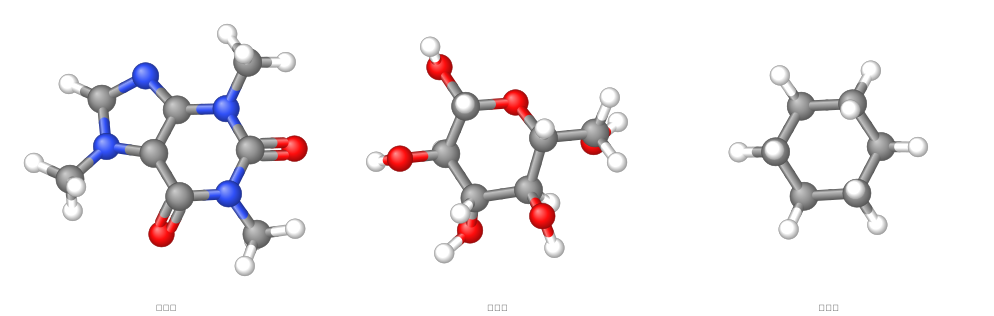
Coordinates from Mol.conformer(), drawn by omgkit — the ring puckers and the
substituent orientations are what the numbers below actually contain. Drawing
them is 3D molecule figures.
It is deterministic
There is no random seed, and there is no retry loop. The same molecule always comes back with the same coordinates:
>>> omgkit.parse_smiles("CCO").conformer().coords == omgkit.parse_smiles("CCO").conformer().coords
True
That is not a convenience — it is where the difference in failure rate comes from. The usual pipeline is:
bounds matrix → triangle smoothing → sample one distance per pair from its
interval → metric-matrix embedding → refine → if it fails, re-sample and repeat
The problem is the sampling step. Each pair is drawn independently, so the
resulting table often describes distances no 3D arrangement can satisfy — "A is
3 m from B, B is 3 m from C, A is 10 m from C" is easy to write down and
impossible to draw. The standard response is to discard the whole attempt and
re-draw, up to 10×N times. When the cause is structural rather than unlucky,
all 10×N retries fail the same way.
omgkit keeps the embedding and replaces only that step. After triangle
smoothing, the upper-bound matrix U satisfies the triangle inequality by
construction — it is a metric, a distance table that can be drawn — so it is
used directly as the reference table. On the same batch of bounds matrices:
| spectrum: negative share | spectrum: top-3 share | geometry: out-of-bounds RMS | |
|---|---|---|---|
| sampled from the interval | 0.284 | 0.463 | 0.812 Å |
U used directly |
0.042 | 0.889 | 0.323 Å |
Failure rate
On a 8831-molecule drug-like corpus:
| failures | ||
|---|---|---|
| RDKit ETKDGv3 2025.09.2 | 36 (0.41%) | mostly metal complexes |
| omgkit | 1 (0.01%) | the one case has contradictory distance bounds |
Only contradictory bounds count as failure — the case where not even a self-consistent distance table exists. An embedding that will not fit into three dimensions is not a failure (the extra dimension is collapsed and refinement recovers it), and refinement that does not converge is not a failure either (you get the best coordinates so far, plus an honest residual). The product of this step is a starting point: one that is slightly off can be fixed, and having none cannot.
What "not a failure" costs
Those two non-failures are real, and they have numbers. On the same corpus, out of 8830 structures produced:
| refinement did not converge | 443 (5.02%) | you get the best coordinates so far, and converged is False |
| at least one bond outside its bounds by >0.1 Å | 13 (0.15%) | mostly thiocyanate-bridged metal complexes |
| 1-2 bond distances outside bounds | 19 / 256955 pairs (0.007%) | |
| 1-3 angle distances outside bounds | 584 / 434872 (0.134%) | |
| bond crossings | 0 |
converged and energy are on Conformer for exactly this reason: a structure
that did not converge is still worth handing to a force field, but you should be
able to tell.
Metal complexes
The metal-complex gap comes from the bounds table rather than from the solver.
For a centre with more than four ligands, RDKit writes the 1-3 bound as
[1.0, 1.2×(b₁+b₂)] — the source comment calls the lower value "an arbitrary
min angle", and the upper one is wider than 180°. That leaves six ligands with
effectively no angular constraint, the metal lands on the centroid, and the
embedding check then rejects it. omgkit uses an angle envelope indexed by
coordination number, which is the same code path for every coordination number.
What comes back
coords |
(x, y, z) per atom, in Å |
mol |
the molecule the coordinates belong to — see the warning below |
energy |
the error function after refinement; 0 means every distance landed inside its bounds |
energy_before |
the same before refinement, so the two together say how much work refinement did |
converged |
whether the gradient reached the tolerance |
iterations |
how many refinement steps it took |
chiral_total / chiral_ok |
how many stereocentres there are, and how many came out with the right sign |
The coordinates belong to conf.mol, not to the molecule you called it on
Generation needs explicit hydrogens, so it works on a copy and adds them
there. Your molecule is left untouched, and conf.coords lines up with
conf.mol, which has more atoms.
chiral_ok should always equal chiral_total. Anything else means a centre
came out as its enantiomer, and it is worth checking rather than assuming:
Global chirality is fixed by one discrete step, not by refinement. Flipping the
handedness of a structure is a reflection, which is not in the connected
component of SO(3): a continuous descent from a structure to its mirror image
would have to pass through a completely flat molecule, and no penalty weight
makes a descent method pay that. So both mirror images are scored once and the
better one is kept.
Writing it out
Conformer.to_molblock() gives the contents of a .mol file. An .sdf is
those records separated by $$$$:
with open("out.sdf", "w") as f:
    for smi in ["CCO", "C[C@H](N)C(=O)O"]:
        conf = omgkit.parse_smiles(smi).conformer()
        f.write(conf.to_molblock(title=smi))
        f.write("$$$$\n")
L-alanine
  omgkit

 13 12  0  0  0  0  0  0  0  0999 V2000
   -1.1906   -0.8985   -0.0732 C   0  0  0  0  0  0  0  0  0  0  0  0
   -0.2162    0.1825    0.3404 C   0  0  0  0  0  4  0  0  0  0  0  0
Aromatic bonds are kekulized on the way out — a molblock has no aromatic bond type. The second line is the program name with no timestamp, so writing the same molecule twice gives byte-identical output.
Reading such a file back gives the stereochemistry back too; see
Reading and writing .mol and .sdf files.
Drawing it
Conformer.to_svg() draws the
conformer as a space-filling, ball-and-stick, stick or wireframe figure — see
3D molecule figures.
Errors
ValueError is raised when the molecule cannot be sanitized, or when its
distance bounds contradict each other. The message says which, and for
contradictory bounds it names the pair of atoms whose interval came out empty.
What this is not
- Not a conformer ensemble. One molecule in, one structure out.
- Not a search. No torsion scanning, no clustering, no energy window.
- Not a force-field-minimised geometry. The error function here is distance and chirality violation, not MMFF or UFF energy. Bond lengths and angles are reasonable and the stereochemistry is right; everything else is what a real force field is for.
The Rust API
use omgkit_conf::pipeline::conformer_for;

let mut m = omgkit_io::smiles::parse("C[C@H](N)C(=O)O")?;
let conf = conformer_for(&mut m)?;   // m is sanitized and given explicit Hs in place
assert_eq!(conf.coords.len(), m.num_atoms());
conformer_for takes &mut MolBuilder and modifies it — that is where the
explicit hydrogens go. The Python binding copies first, which is why
conf.mol is a separate molecule there.